20+ Other Ways to Say “If Time Permits”
The phrase “if time permits” can make it hard to communicate clearly in your emails. Understanding if time permits meaning can help make your message clearer. In a world where being clear and polite is very important, learning different time-related expressions can make your work communication better.
This article shows 20+ English ways to talk about scheduling and gives polite English phrases that will impress the people you write to.
Should Time Allow
In professional communication, showing that plans depend on something can make your message clear and respect other people’s time. Phrases like “Should the opportunity arise” or “If circumstances allow” are polite and show you understand that schedules can change.
Example:
Email from Rida to her team:
Hi Team,
We will review the quarterly report next week, should time allow. Please prioritize the urgent tasks first.
Best,
Rida
Here, “should time allow” gently sets expectations. It’s a great polite way to say if time permits in professional emails or official announcements.
Pending Time Constraints
When talking about project planning words, it is important to show flexibility without sounding unclear.
Example:
Project update email from Mark to the client:
Dear Ms.Kim,
We can integrate the new feature into the product roadmap, pending time constraints and resource availability. I will keep you updated on any changes.
Regards,
John
This expression highlights time constraints expressions clearly, making it suitable for formal settings where schedules are tight.
Time Willing
“Time willing” is a poetic way to remind us about our time. It gently shows optimism, meaning that even though life changes, our hopes and dreams can happen soon.
Example:
Casual team chat message from Alex:
Hey everyone, let’s grab lunch tomorrow, time willing. I’ll send out a calendar invite if it looks good.
This phrase shines in informal contexts and adds a touch of charm while talking about plans dependent on time.
Contingent Upon Time
In professional communication, knowing the small details of time-dependent phrases is very important, especially in legal settings.
Example:
Corporate invitation email:
Participation in the workshop is contingent upon time and prior registration. Please RSVP at your earliest convenience.
It’s an excellent example of formal conditional time expressions and communicates clear boundaries.
If Time Is Kind
If we think of time as a force, it becomes a strong friend in our path of personal growth and healing. Time, with its endless ability, helps us see our experiences more clearly. What once felt too hard often changes into just a part of our story, changing how we look at challenges.
Example:
Email from Laura to a conference speaker:
We hope to make the Q&A session longer, if time is kind to us after the main presentations. Thank you for your flexibility.
Using this phrase gives a positive tone and works well in both formal and informal situations.
If the Schedule Permits
If the schedule allows, finding ways to add something extra into our busy lives can bring unexpected rewards. Maybe it is trying a new hobby, helping with a local cause, or just taking time for self-reflection.
Example:
Event coordinator’s email to participants:
We plan to have a networking session at the end of the day, if your schedule permits. Please stay tuned for updates.
It is one of the best time availability phrases for meetings, conferences, and workshops.
Assuming Time Is On Our Side
Assuming time is on our side shows hope that time can be a healer, a teacher, and a quiet helper in our goals. In a world often full of hurry, this view encourages us to move our focus from quick results to the growth that happens quietly underneath.
Example:
Team meeting agenda email from Daniel:
We will cover the main topics first, assuming time is on our side to talk about extra questions afterward.
It gives a human touch and flexibility to your plans.
Where Time Allows
In a world where strict schedules often control our lives, the idea of where time allows invites us to accept flexible timing as a way to build deeper connections. This mindset encourages gentle words in our interactions, helping us enjoy moments instead of rushing through them.
Example:
Professor’s note to students:
We will explore extra case studies where time allows during next week’s lectures.
It works well in academic and educational contexts and invites flexible learning opportunities.
In Time’s Favor
In the ups and downs of our daily lives, seeing time as a friend instead of an enemy can change our experiences. The idea that time is full of potential encourages hopeful expressions about the future.
Example:
Meeting summary email from Olivia:
Extra topics will be discussed if time is in our favor. If not, they will be moved to the next session.
This phrase is great for flexible scheduling and meeting planning.
Given Adequate Time
In today’s fast-moving world, the importance of time is often hidden by a focus on speed. However, having a mindset that values quality over rushing can change results in both personal and professional areas.
Example:
Project lead’s email to stakeholders:
With enough time, we will do a complete analysis of the feedback before finishing the report.
It works well in formal discussions where thoroughness is important.
At Time’s Leisure
In the gentle approach of at time’s leisure, we often find the hidden beauty in everyday life. The skill of enjoying moments comes through unhurried actions, letting us connect fully with our surroundings. Imagine drinking tea as the steam rises, mixing with thoughts, while the world moves fast — showing the richness found in slowing down.
Example:
Creative team leader’s email to writers:
Feel free to review the draft at time’s leisure before the final submission deadline.
It works well in creative or intellectual environments where flexibility is valued.
As Time Permits
As time allows, the idea of flexible task scheduling has become more important in our fast-moving lives. Accepting this idea helps us move away from strict deadlines, encouraging a more adaptable way of handling our responsibilities.
Example:
Customer support email from Jenna:
We will handle each of your concerns as time permits throughout the week.
It is useful in many areas, from customer service to education.
Should Time Be Generous
Time, often seen as a strict ruler, can surprisingly become a kind ally in our goals. Imagine a world where more time is part of our daily lives, giving us space to grow ideas instead of just rushing against the clock.
Example:
Workshop coordinator’s note:
We will explore advanced topics if time is generous during the session.
It shows optimism without making any promises.
If Time Allows
Life often feels like a hurry, but we can pause to enjoy if time allows moments. Imagine a slow afternoon, a friend’s sudden invitation, or the chance to try a new hobby.
Example:
Email from Michael to his project team:
We will add a bonus training module if time allows after covering the basics.
It is useful for informal and semi-formal communication.
If Time Is Available
Time can often feel like a luxury, but when it is available, it opens chances to improve our professional communication. In a world full of quick messages and instant replies, using this resource lets us pause and make our email clarity better.
Example:
HR email regarding interviews:
Extra interview slots will be scheduled if time is available later this week.
It emphasizes time availability in meetings and schedules.
When Time Permits
When time allows, the skill of flexible timing becomes important in handling the many tasks we manage every day. Conditional actions, doing things only when we have the space, can change how we handle our to-do list
Example:
Email from Emma to volunteers:
Please submit your reports when time permits meaning to ensure accuracy.
It is good for polite and flexible requests.
If Circumstances Allow
Navigating life’s possibilities often depends on conditional expressions that show our changing situations. When we say if circumstances allow, we recognize the important role that time and other changing factors have in our decision-making.
Example:
Community organizer’s update:
We plan to hold the outdoor event if circumstances allow, considering weather and time limits.
It works well for casual or formal announcements where many factors are involved.
In the Event Time Permits
In professional communication, the phrase in the event time permits gives a subtle but strong conditional meaning that can change expectations. It shows the balance between ambition and reality, recognizing the uncertainty of timelines while keeping a focus on thoroughness.
Example:
Contract clause:
Extra services will be provided in the event time permits and resources are available.
It is useful for clear conditional intent expressions and precise planning.
Subject to Time Availability
In a world where time is money, the idea of time-dependent planning has become very important in many areas. People and organizations must manage the details of conditional scheduling, matching their plans with the availability of resources and stakeholders.
Example:
Vendor contract email:
Delivery of materials depends on time availability and shipping schedules.
It is ideal for professional or transactional communication.
Read More:27 Amazing Ways to Say “I Look Forward to Working With You”
When Schedule Allows
When a set timetable is not strict, the chance for creativity and spontaneity grows. In a world where structured planning often controls workplace scheduling, it is easy to forget that flexibility can drive innovation.
Example:
Manager’s email to staff:
Training sessions will be held when the schedule allows, likely in the coming quarter.
It works well for scheduling based on time contexts.
Pros and Cons of Using “If Time Permits”
Pros:
- Polite and neutral
- Flexible and non-demanding
- Suitable for various contexts
- Easy for English learners to understand
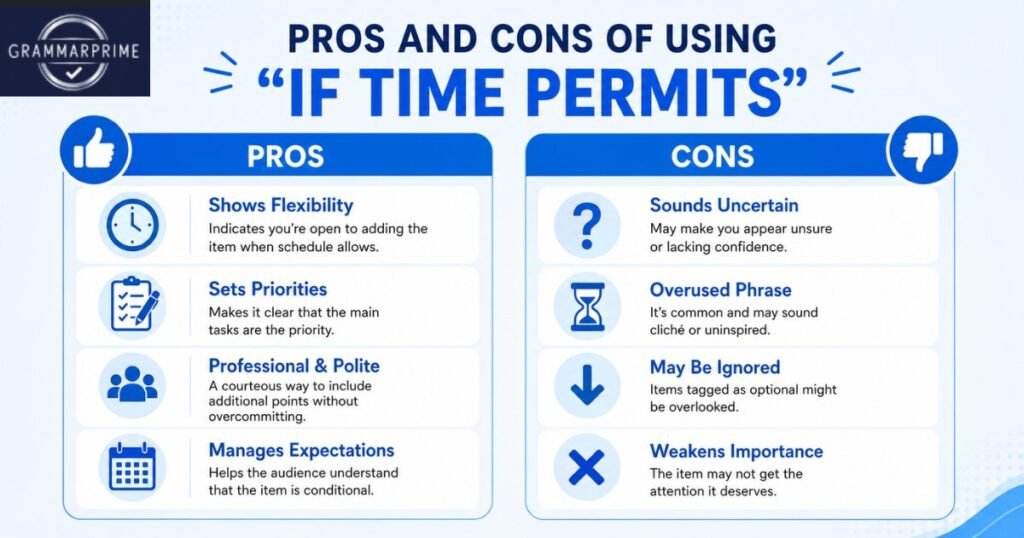
Cons:
- Can sound repetitive
- Slightly formal for casual conversation
- Limited expressive nuance
- May not always reflect urgency
Provided Time Is Sufficient
Effective time management depends on understanding that the provided time is enough to finish tasks. This idea goes beyond simple scheduling; it involves skillfully using formal expressions to explain expectations clearly.
Example:
Project manager’s note:
Testing will begin next month, provided time is enough to finish preparations.
It is great for setting expectations clearly.
Summary Table of Alternatives to “If Time Permits”
Read More: 26+Alternative Ways to Say “Please See the Email Below”
| Alternative Phrase | Typical Use Case | Tone | Example Scenario |
| Should Time Allow | Formal emails | Formal | Reviewing reports in work emails |
| Pending Time Constraints | Project management | Professional | Feature integration update |
| Time Willing | Casual conversations | Informal | Casual team lunch plan |
| Contingent Upon Time | Official documents | Formal | Workshop participation invite |
| If Time Is Kind | General use | Optimistic | Extending meeting Q&A |
| If the Schedule Permits | Events, conferences | Neutral | Adding networking session |
| Assuming Time Is On Our Side | Optimistic planning | Casual/Formal | Covering extra agenda topics |
| Where Time Allows | Educational settings | Neutral | Exploring case studies |
| In Time’s Favor | Flexible scheduling | Optimistic | Discussing extra topics |
| Given Adequate Time | Formal project planning | Formal | Conducting detailed analysis |
| At Time’s Leisure | Creative/intellectual | Poetic | Reviewing drafts |
| As Time Permits | Versatile | Neutral | Customer support responses |
| Should Time Be Generous | Workshops/meetings | Hopeful | Exploring advanced topics |
| If Time Allows | Casual/professional | Neutral | Adding bonus training |
| If Time Is Available | Clear professional | Neutral | Scheduling interviews |
| When Time Permits | Flexible requests | Polite | Submitting volunteer reports |
| If Circumstances Allow | Broad conditional | Neutral | Planning outdoor events |
| In the Event Time Permits | Legal/formal documents | Formal | Contract clauses |
| Subject to Time Availability | Transactional/professional | Formal | Delivery scheduling |
| When Schedule Allows | Structured workplace | Neutral | Scheduling training sessions |
| Provided Time Is Sufficient | Precise professional | Formal | Testing preparation |
Conclusion
Exploring other phrases instead of if time permits can improve your communication style and make your messages clearer. Using expressions like should time allow or time permitting meaning shares the same meaning with a fresh touch.
Each option keeps the original idea and adds a bit of sophistication to your words. The key to good communication is your choice of words, so try these alternatives. Use these phrases in your next talk or written work, and see the positive effect they can have!
FAQs
What does If Time Permits Mean?
The phrase if time permits is often used to show that an action or decision depends on having enough time. It means that while someone may want to do a specific task or activity, they understand that time constraints might limit their ability to do it.
What does If the Situation Permits Mean?
The phrase if the situation permits refers to a conditional case where certain actions or decisions can happen depending on the context or conditions of a situation. It means there may be limits, restrictions, or variables to consider before moving forward with a plan or idea.
What does It Mean as Time Permits?
As time permits means doing a task or activity when there is enough time or opportunity to do it. It shows that the action is not urgent or required and can be postponed until there is time to focus on it.
How do You Professionally Say Time Consuming?
To say that something is time-consuming in a professional context, you can use phrases like “requires significant time investment” or “involves a considerable commitment of time.”