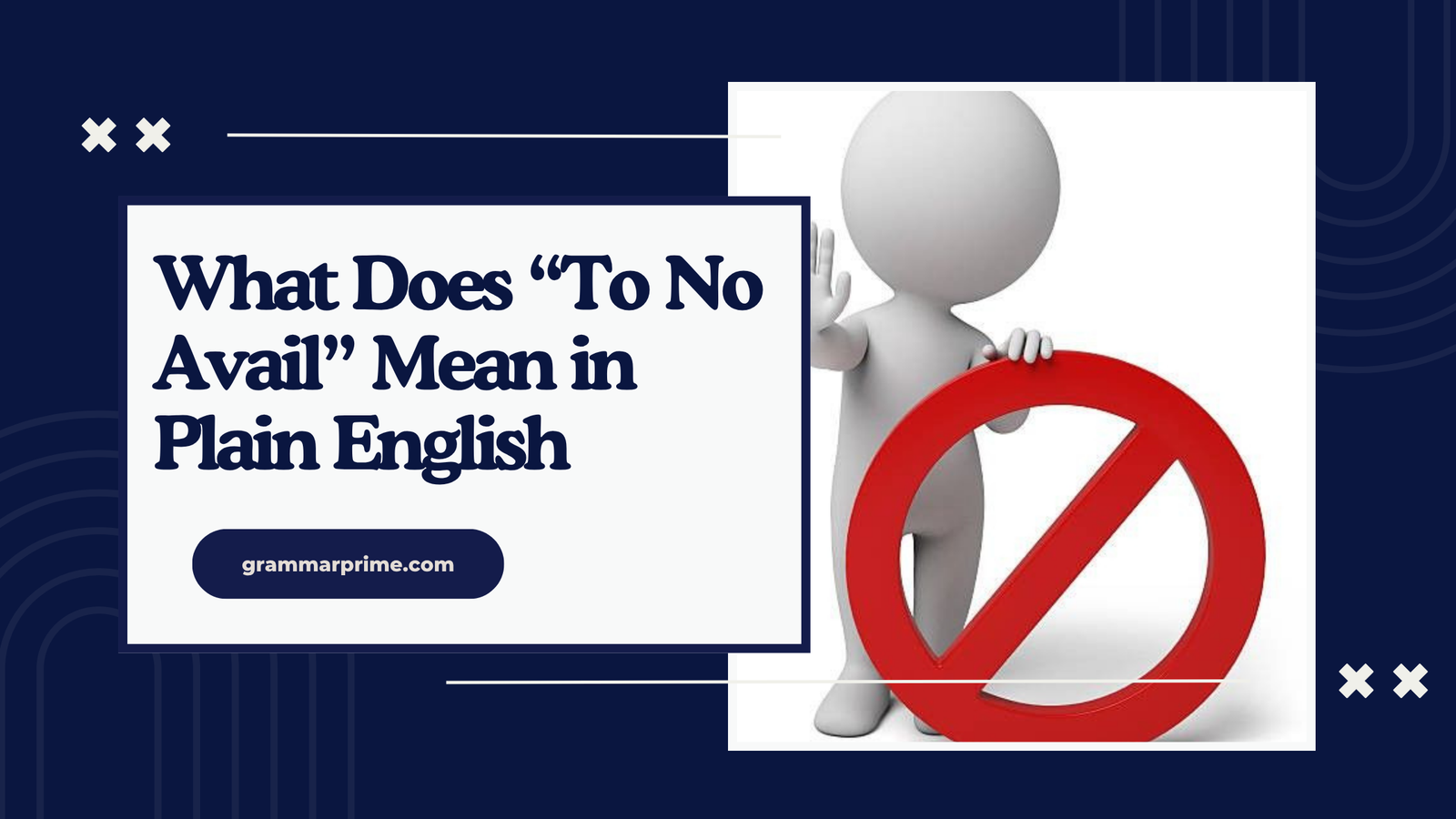
What Does “To No Avail” Mean in Plain English
When you do something “to no avail,” it simply means your hard work yielded absolutely zero results. You gave it your best shot, but you ultimately failed to achieve what you wanted.
Think of it like sprinting to catch a departing bus, only for it to pull away right as you reach the door. That is effort to no avail.
The core word here is “avail,” an old-school term that translates to profit, use, or advantage. Therefore, the phrase literally means “without any benefit.” While it carries a slightly formal ring to it, Americans across the country use it seamlessly in everyday writing, news broadcasts, and daily speech.
The Quick Breakdown:
- Action taken? Yes. ✓
- Goal achieved? No. ✓
- Outcome? Pure frustration. ✓
The Surprising Origin and History Behind “No Avail”
The linguistic roots of “avail” stretch back to the 1400s, borrowing from the Old French verb valoir, which means “to be worth.”
As the English language evolved, speakers began combining it with the word “no” as a dramatic way to describe utter futility. By the 19th century, the phrase had cemented its place as a staple in classic literature, courtroom arguments, and official correspondence.
Legendary authors like Mark Twain utilized similar phrasing, and American civil war journalists frequently relied on it to describe courageous military charges that ultimately failed against heavily fortified enemy lines. The idiom has endured for centuries because it perfectly captures a universal human experience: giving something your all and coming up empty-handed.
Real-Life Examples of “No Avail” Used in Sentences
The easiest way to master a phrase is to see it in context. Here are a few relatable, everyday examples:
- “She spent an hour on hold with tech support, to no avail.”
- “He adjusted the antenna multiple times, but to no avail—the screen remained static.”
- “The defense attorney argued passionately for a lighter sentence, to no avail.”
- “We searched the entire parking lot for our car, to no avail.”
- “Emergency crews worked through the night to clear the blocked highway, to no avail.”
Pro-Tip: Notice how the phrase always follows a specific action? It is best to avoid starting a sentence with it (e.g., “To no avail, she looked…”). While grammatically permissible, it sounds a bit clunky and overly theatrical.
Common Situations Where Americans Use “No Avail” Every Day
You will encounter this idiom far more often than you realize. It is incredibly popular across several industries:

- In the News: Journalists rely on it for tight storytelling. “Diplomats negotiated until dawn to prevent the strike, to no avail.”
- Medical Settings: Healthcare professionals use it in official reports to document treatment outcomes. “Multiple medications were administered to no avail.”
- Customer Service Grievances: It is the ultimate phrase for internet venting. “I emailed the company three times to no avail.”
- Sports Broadcasting: Analysts use it to describe a losing team’s late-game surge. “The Celtics mounted a massive fourth-quarter comeback, to no avail.”
When Americans use this phrase in personal stories, it isn’t usually meant to convey anger. Instead, it signals a sense of quiet acceptance—a recognition that they did everything they could, but it just wasn’t meant to be.
Read more about SS Meaning in Chat: What “SS” Really Means in Messages, Social Media & More
Synonyms and Alternatives to “To No Avail” You Should Know
If you want to mix up your vocabulary, you can swap the phrase out for several great alternatives depending on the vibe you want to strike:
| Formal & Professional | Casual & Conversational |
| Without success | Got nowhere |
| In vain | Came up empty |
| Fruitlessly | Hit a brick wall |
| To no effect | No luck |
| Without result | Didn’t pan out |
While “in vain” is its closest sibling in terms of formal weight, “to no avail” feels a bit more analytical. Let your setting dictate your choice: use “no luck” when texting a friend, but stick to “to no avail” when drafting an update for your boss.
Common Mistakes People Make When Using “To No Avail”
Even native English speakers mess this one up from time to time. Keep an eye out for these four common pitfalls:
Mistake 1: Leaving it stranded without an action
- Wrong: “To no avail, the project failed.”
- Right: “We revised the project proposal twice, to no avail.”
- Why? The phrase requires a preceding action to give it meaning.
Mistake 2: Confusing it with “to no end”
These two sound similar but mean completely different things. “To no end” means constantly or excessively (e.g., “He complained to no end” means he wouldn’t stop talking). They cannot be used interchangeably.
Mistake 3: Dropping it into ultra-casual chats
Because it is a slightly sophisticated phrase, using it while chatting over coffee or playing video games can make you sound a bit robotic. Save it for your writing, professional emails, or formal storytelling.
Mistake 4: Fumbling the spelling
It is incredibly common to see typos like “to no avale” or “to no availe.” Just remember it ends in -ail, just like a failing grade.
Conclusion
At the end of the day, “to no avail” is a classic, highly precise idiom that perfectly describes an effort that resulted in a dead end. Use it when you want to add a layer of dignity and honest weight to a situation where someone tried their best but fell short—and your writing will instantly hit the mark.
FAQ’s
Is “to no avail” formal or informal?
It definitely leans formal, but it is deeply embedded in mainstream American English. You will see it constantly in literature, news media, and professional emails.
Can you start a sentence with “to no avail”?
You can, but it is generally discouraged because it creates an awkward, overly dramatic sentence structure. It flows much better at the very end of a thought.
What is the difference between “in vain” and “to no avail”?
They are functionally identical. However, “in vain” carries a slightly more poetic, emotional undertone, whereas “to no avail” sounds a bit more objective and factual.
Is “to no avail” still commonly used in the US?
Yes, absolutely. It remains a standard idiom across corporate America, journalism, legal documents, and everyday writing.
What part of speech is “avail” in this phrase?
In this specific context, “avail” functions as a noun that represents utility, advantage, or beneficial use.